
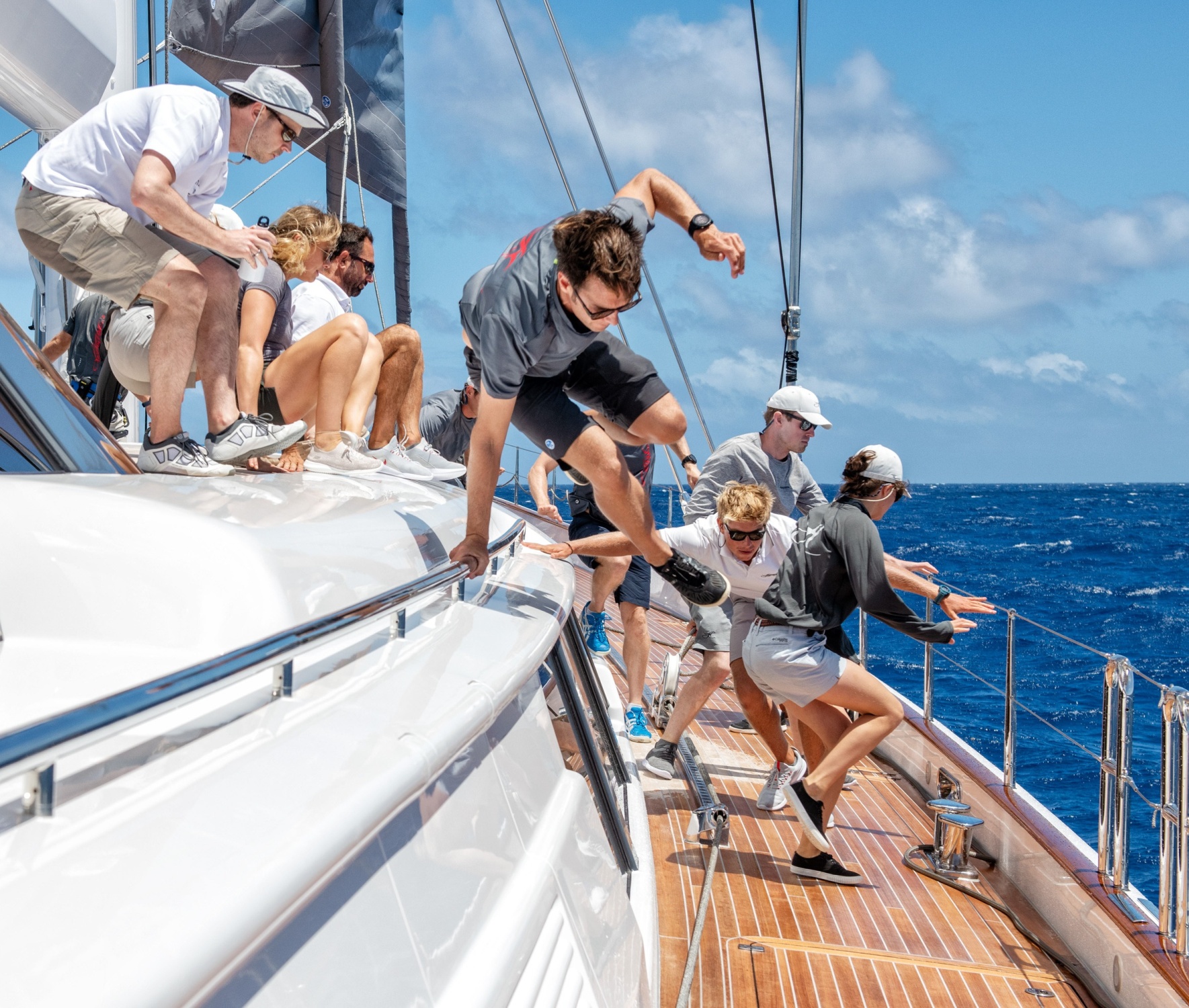
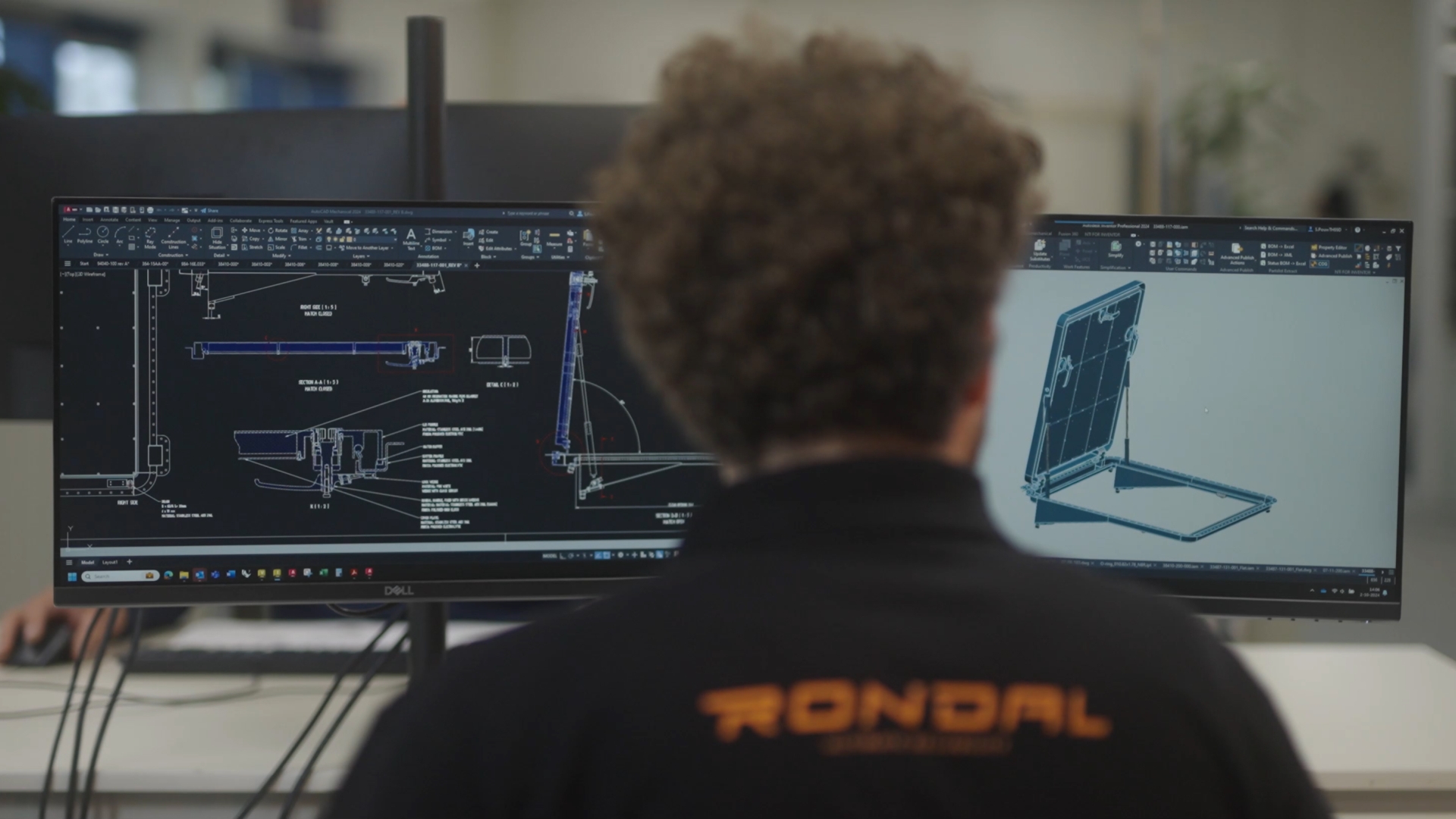
Behind every high-performance Rondal system is a team of engineers turning complex demands into seamless solutions. We sat down with Marco Lips (50), senior engineer who has been with Rondal since 2009. He spends his days working on one of the most essential, yet often underestimated parts of a superyacht: the hatches, entrances and windbreaks that connect inside and outside life on board.
“It may sound simple,” Marco begins, “you start with an opening in the deck. That opening must close and also open. It must be watertight, safe, functional and at the same time beautiful. If even the smallest detail is overlooked, the entire system fails. That is why precision is everything.”
The role of the engineer
Engineering at Rondal means much more than drawing a part. It is problem solving at the highest level. From 3D modeling and detailed drawings to strength calculations and material choices, engineers anticipate every scenario a yacht might face at sea. Doors and windbreaks are fitted with sensors and contact strips that guarantee safety in operation. Fail-safe logic ensures that, even in emergencies such as fire, the system responds exactly as it should.
Every layer of powder coat, every material grade and every weld is considered and tested. As Marco explains: “We are not just building something that works today. We are building something that will continue to perform reliably, day after day, year after year, in the toughest marine environment imaginable.”
Marco recalls a moment that shows what that reliability looks like in practice: “On a project with a four-panel electric sliding door for CRN, I was called to the workshop when the system had just been tuned. Watching the panels glide open and close so smoothly, I thought: yes, this is exactly how it should be.” Another highlight for him was the windbreak built for Ocean Victory at Fincantieri: “Seeing everything in such a complex product comes together on a yacht of that scale was a true achievement.”
From request to delivery
A project at Rondal rarely follows a standard path. Even so-called “standard” products require tailoring. The process begins with sales, then passes to engineering, where the design is adapted to meet project-specific needs. In basic engineering a proven principle is customized; in detail engineering the full set of drawings is created. For approval, a general arrangement is shared with the client and sometimes a classification society like DNV, RINA or Lloyd’s.
Once approved, engineers deliver a package of production drawings (anywhere from 50 to 200 sheets) that guide the build like an IKEA manual, but for high-performance yacht components. Then follows production, a factory acceptance test (FAT) in the Rondal workshop and finally installation and the harbour acceptance test (HAT) together with the client’s team.
For fully custom projects the journey is even more complex. Engineers may begin with a design study, exploring multiple options, or a concept engineering phase, developing ideas into workable solutions. With every millimeter counting, a 3D scan from the shipyard is typically needed. Weekly project meetings keep every detail aligned. And what looks effortless to the end-user is in fact the result of meticulous engineering discipline. Sascha recalls a project where complexity reached a new level: “It was a challenging build with an ambitious timeline and a new design concept. Along the way, expectations evolved, but our team adapted quickly and kept the focus on quality. In the end, we delivered beautifully engineered hatches (virtually error-free) and received full Lloyd’s approval without a single remark. Looking back, it’s a great example of what we can achieve together when the pressure is on.
Technical demands and materials
The demands are substantial. Hatches and windbreaks must cope with pressure, movement, salt water, heat and vibration, while at the same time blending seamlessly into the yacht’s architecture. Achieving watertightness requires ongoing research and innovation, as every project presents new challenges. Materials must combine strength with elegance, ensuring uncompromising performance without ever sacrificing design. Rondal engineers primarily work with seawater-resistant aluminum grades and stainless steel. When it comes to aluminum, specific grades are selected for their mechanical properties and resistance to corrosion. For example, 5083 H111 is commonly used where forming is required, while 5083 H321 offers more rigidity. For extrusions, 6082 in T4 or T6 condition provides the needed strength. The choice of material is always project-specific, depending on the demands of shape, strength and durability.
What sets Rondal apart
According to Marco, it’s not one big thing, but rather the way technical expertise, client focus and consistent quality come together. Clients appreciate that our engineers think along with them, explore possibilities and aim for solutions that are not only functional but also well made and thoughtfully integrated.
Above all, Rondal delivers reliability. Every system is tested thoroughly before it leaves the workshop. Thanks to the FAT and HAT procedures, we know (and the client knows) that everything works as it should. Once installed, our team stays involved for checks and support on board. “Our work is successful when no one has to think about it,” Marco says. “If the hatch opens and closes smoothly for years, if the windbreak just works as expected, every time, then we’ve done what we set out to do.”
That’s what sets Rondal apart: systems that do their job quietly and reliably, so others can focus on sailing.


guillaume-plisson-1147-sky.jpg&resolution=772x482&quality=100?type=webp)