
-resizec.jpg?resolution=1920x1080&quality=100)
With Rondal celebrating its 50th anniversary this year, sharing a little history is part of the celebration. Rondal is inseparable from the history of Royal Huisman, even back to its founding days, when a boatbuilder made everything except the glass for the portholes, the engine, and sails. And so it was into the 1970s at Huisman, where the custom yachts for racing or cruising received custom Huisman spars.
In 1976, Wolter Huisman, who was then at the helm of the company, spun his shipyard's mast-making department into an independent business. He called it Marquip for "marine equipment," and it expanded to become an industry leader in aluminum masts, booms, hatches, and hardware. In just 13 years, the company had evolved beyond its original identity and was shipping production parts far and wide. Wolter decided to rebrand the company as Rondal, combining letters from the town where the shipyard began, Ronduite and aluminum, the material where Wolter really made his mark.
That was also the year of a great step forward in mast making, when Huisman produced his first mast made from curved aluminum plates rather than an extrusion. The breakthrough enabled variable plate thickness and an accurate taper, reducing weight and lowering the center of gravity. That the restored J Class yacht Endeavour was getting this new mast was a marvel itself and brought Rondal center stage.
Celebrating 50 years is the perfect time to take stock and also to share plans for the future. The marketing staff sat with Rondal's Managing Director, Harald Lubbinge, for a review of the company's strengths and a look ahead:
Rondal went through a significant transformation from aluminum to mostly carbon products. What is your professional background? Did you have contact with these materials or composites in general before, and in what way was it helpful?
My background is in leading technology-driven manufacturing organizations: operations, delivery, and building teams that can scale without losing quality. Before Rondal I worked in senior roles such as COO / Director of Projects in international, project-based environments. On composites: Rondal already had world-class specialists. Where my experience helps is in the disciplines that make advanced composite production succeed consistently: process control, planning, risk management, and quality systems. Carbon is an incredible material, but only if you can deliver it with repeatability and confidence. That’s where leadership and structure really matter.
Which parts or segments of the company did you focus on when you joined Rondal?
First, focus and standardization. When I joined, many products were still approached as individual project solutions. We worked to turn recurring systems, especially winches and mooring winches, into more standardised products. That improves quality, delivery time, cost control, and reliability. Second, systems thinking. Rondal’s real value is not just in components, but in integrated solutions that work together: engineering, production, and service aligned around what the yacht actually needs.'
What does Rondal manufacture today?
Masts and booms, of course. We build in aluminum and composite, and we can build the largest one-piece composite mast in the world, up to 90 to 95 meters. Currently, we have four large carbon fiber masts in production for Royal Huisman sailing yachts under construction.
Hatches, winches & feeders, mooring winches, hydro generators, and windbreaks and doors. We also make custom composite parts, such as biminis and radar masts. I think it's also wise to focus, not to do so many different things.
We have winches with up to 32 tons of pulling power, and we developed them for a yacht now under construction at Royal Huisman. We have built them up from one of our standard models with 24-ton capacity, so we have a complete range of standardized winches up to 32 tons.

One of the most important items now, from a revenue perspective, is our mooring winches. This is a very smart adaptation of our sheet and halyard winches. Yachts above 3,000GT have to use mooring winches. But below that tonnage, there are yacht owners who want a mooring winch for a clean deck. Recently we sold a big sailing yacht, 14 mooring winches.
Actually, mooring winches are a good example of improvements in our business strategy.I worked previously in the automotive industry, where we tried to do as much [standardization] as possible. I told the engineers, I do not want a new winch every time. When I came here, every project had a different winch with a different frame or a different drum. Why? Below deck, I just need good winches, and I want a standard one. So, they developed standard winches. And now we sell quite a lot of those winches. With the basic components already developed, we can start assembling the winches immediately. Previously our winches were projects, now they are products That's a big advantage. Our price is lower. And we can deliver quick.
What are the areas of Rondal’s services and production where you feel the company has the most competitive advantage?
We have an engineering team of 25 to 30 people in our workforce of about 100, which includes temporary workers. The engineering team gives us the flexibility to respond to new custom projects and work with customers to develop their new projects. Many engineers can design things, but Rondal engineers are specially trained in the physical properties of high-tech materials. We deliver complete integrated sailing systems, including the mast, installation, commissioning, etc. We have everything in-house. I am convinced that’s such a big advantage. We are also one of the only one or two companies in Europe that can still build big aluminum masts. This is important for the refit market, and we are delivering high-tech tapered aluminum masts that reduce aloft weight for yachts seeking to improve performance. We did replacement furling masts for a 49 meter Perini Navi ketch recently for just that reason. Aluminum masts are also less expensive than carbon. While we would like to build masts for production sailing yachts, our best market is for custom, one-offs.

What about development of wing sails?
Wing sails onboard for example catamarans have a strong potential and signal a shift in the market. Owners want lower emissions and smarter energy use, but they also want solutions that are safe, practical, and easy to operate. What I like is the maturity of the project: we completed the concept phase and received Lloyd’s Register Approval-in-Principle for the Aero WIng. That’s a meaningful step, because it validates the design and safety principles and helps move toward real-world application. We took this a step further with promising catamaran projects (Dragonfly by Dixon Yacht Design and Royal Huisman’s Aera). Working with Artemis Technologies we developed the design for a wing sail large enough to serve superyachts.
Rondal is exploring new markets like captive winches for big motor yachts. Are there any other non-sailing sectors that Rondal is keeping an eye on?
Yes, two directions stand out. The first is the motor yacht market: systems that improve comfort, safety, and reliability: mooring winches, windbreaks, entrances, sliding door solutions. That’s where our promise fits perfectly. We design for ease of mind. The second is crossover innovation. Wind-assisted propulsion like the wing sails is gaining momentum beyond yachting, and composite engineering capability also translates well to specialized, high-tech one-off applications. We’re selective, but the opportunities are real.
What are the areas targeted for growth and development at Rondal?
For the next 5 to 10 years, I see growth for Rondal in motor yachts. Windbreaks are a big feature. Going back to the days when Rondal made the first curved and powered sliding glass doors, we have expertise in glass, steel, and aluminum, and now we are building the largest windbreak of nearly 30 meters ever ordered. It's for Rev Ocean under construction at Damen Shipyards. But the advantage is, it's based on our standard components. The slide system is all standard components. Our sales guys are on the road, and they have a lot of requests for quotes from Turkey, Italy, Spain, Germany, and, of course, also the Dutch shipyards. Those, along with the mooring winches I mentioned earlier, open the motor yacht market for us. We see some advantage in this area.
How is Rondal using new tools such as AI?
Of course we use AI, but not that much. At least not in our projects. But we use it in our work. For example, in engineering, I think we can do more with AI. I know companies will do quite a lot with AI in engineering, especially in the concept phase. What we are really projecting out now is collecting sufficient data to bring AI to the machine-user interface for sail controls. I think AI development needs to be done. Sailing can be quite difficult. You need a really big team on board to sail the super yachts. What can you develop to make it easier? I expect we will make developments in automated sailing. I think it's the next step. And then an adaptive automated system.
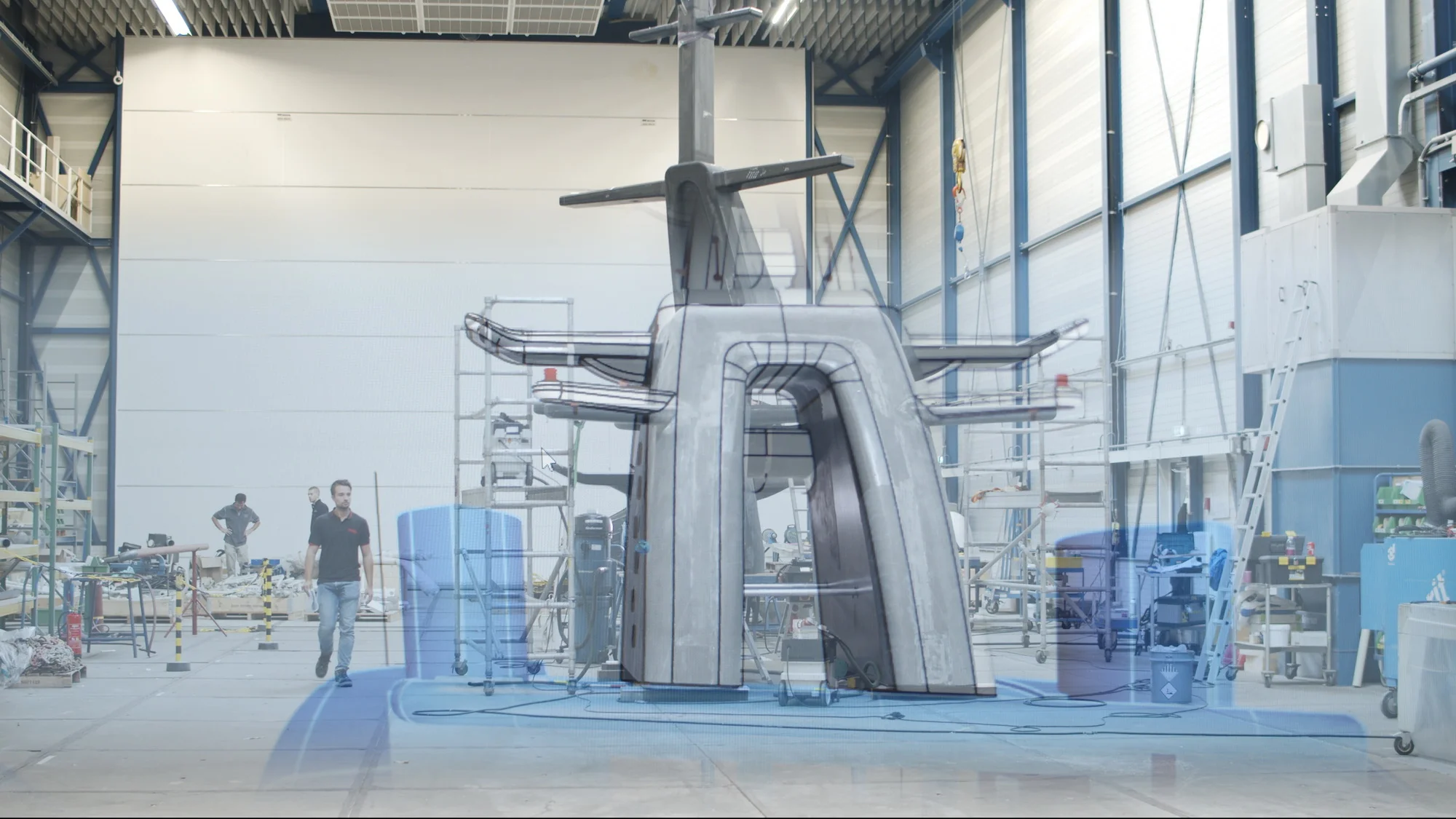
Where can the aluminum roots still be felt at Rondal? For which parts is it indispensable?
First, even as we execute some captive reel winches in carbon today, many winch and hardware applications still make strong sense in aluminum, especially where you want a proven balance of strength, machinability, durability, and serviceability. Second, aluminum remains crucial in the refit and replacement market. A good example is our replacement rig work like the 50m ketch project where we produced a 49m main mast and 36m mizzen mast as an aluminum in-mast furling rig and shipped and stepped it successfully. Ultimately, whether we choose aluminum or carbon, the target is the same: long lifecycle performance and ultimate reliability.
Why is achieving the ISO 9001 standard important to Rondal?
I previously worked at companies that had ISO 9001 certification. I know how it impacts the quality of the work company-wide. We were able to achieve this certification in one year with determination and small adjustments. The ISO 9001 standerd is a recognozed symbol and every year, DNV does and inspection to check if a company is continuing to work according to those standards.


